simbainstitute

Mega Dropdown Courses

Blog

what are some notable features of the best e commerce classes in surat 870x457

Learning E-commerce in this highly competitive digital age can get on your nerves. So, to make the learning path easy, it is important to get admission to the best e-commerce classes available around. However, to figure out the best e-commerce classes in Surat or any other metro city, it is important to check the courses for certain features. It is so because there are so many tutors offering e-commerce classes in these cities, and due to a lack of the right knowledge, one may end up taking admission at the wrong place. The notable features of the best e-commerce classes in Surat are as follows- Marketing – An efficient e-commerce class will teach you promising digital marketing strategies for your website to attract more organic traffic. SEO, PPC, advertising, and social media marketing should all be included in the syllabus.  Business Management – You will get to learn efficient management of an online store, such as setting up and optimizing the process of product listing, and you will also get to work on your customer analytical skills. Design – You should acquire some good design skills to design your business website and application through HTML coding and computer programming.  Product Management – In a good e-commerce class, you will also get to learn the tricky art of managing your products. It is tricky and is very important to ensure a successful venture. It is crucial to understand the competition and select the niche products accordingly. Along with all of this, in a good class, you will also learn the skills to secure transactions and maintain the privacy of customers, along with cross-border commerce regulations and global e-commerce trends.

What are some notable features of the best e- commerce classes in Surat? Read More »

what does one get to learn out of digital marketing training 870x457

Yes, digital marketing training in Surat and its courses and classes are top-rated among people and youth. However, this does not mean one should jump into this sea without proper awareness and information.  So, for those still researching the topic, this guide will be helpful as you will read in detail what one can learn through digital marketing training in Surat or any other city. All covered under digital marketing training goes as follows – Search Engine Optimization – In this, lessons are taught to optimize a website to rank higher in search engines for business-related keywords. Email marketing– Candidates are also trained to formulate attractive Email campaigns for successful business promotion across the web. Social Media Marketing– The digital marketing trainee is also trained in creating attractive social media campaigns. In the process, the trainee also learns the art of content creation, community management and advertising strategies. Content Marketing – Under content marketing, the trainees are taught the art of creating informative and engaging content. The right content can help any business retain its target audience longer. PPC advertising– PPC, or pay-per-click advertising, is integral to any digital marketing training and is taught in digital marketing training programs all over India. Analytics  and data-based decision-making– A candidate is also trained to monitor and optimize campaigns regularly during training. Conclusion – These are all the major topics covered in digital marketing training in Surat and India. If you are into new and creative ideas, then digital marketing training is for you. It will further open various bright career opportunities for you.

What does one get to learn out of digital marketing training? Read More »

whatsapp image 2024 12 28 at 9.31.38 pm 870x457

The world is in a fast-paced digital age; everything has transformed into digital. Digital marketing has become a significant channel for promoting any business. So, digital marketing classes will enhance your knowledge and help you add value to your skill set and resume. As you read further, you will learn why you should take digital marketing classes in Surat and other major cities. Details on reasons to take digital marketing classes in Surat are as follows: Increasing Demand:  As businesses’ marketing approaches shift from traditional to digital, the demand for digital marketing professionals also increases. So, if you complete your course from reputed digital marketing classes in Surat, you have a promising, secure future.  Enhances your creativity and innovative abilities  Joining a digital marketing class provides room for creative souls. Through digital marketing, one can work on the latest ideas and unique approaches to increase the target audience’s engagement.  Flexible Working Setup: In digital marketing, one perk people enjoy is that they are unlike the IT sector, where they need to work from a fixed place at a fixed time. Here, you can work from your schedule and your comfort zone.  Better paying than other jobs –  The salary packages for digital marketing experts are more attractive than those for other job profiles. The people who take up working in the field get paid well right from the fresher-level jobs.  Conclusion-  These are all the reasons to be admitted to digital marketing classes in Surat or any major city flooded with such opportunities. If you need help, you may also ask career advisors.

Why get admission to digital marketing classes? Read More »

whatsapp image 2024 12 13 at 6.29.33 pm 870x457

The digital marketing course in Surat and other major cities is top-rated. It is so because India has recently seen a significant digital shift in its market, and hence, the demand for digital marketing professionals has also increased over time.  So, a digital marketing course in Surat and other business-oriented cities has been a career-promising education program. However, just as one does deep research before selecting a college or a school, before enrolling in a digital marketing course, one should see if the checklist is well matched.  The checklist goes as follows:  Check if the course has experienced module-specific professors.  Look at the modules covered in the syllabus.  Check the course for AI integration. See if the curriculum has case studies for the development of analytical skills. The institute should also be giving offline classes. The syllabus should also have mandatory internships for practical experience. Check the placement records of the institute. So, one should conduct deep research on these matters beforehand. Only then will they be admitted to the best digital marketing course in Surat. Given the tough competition in the market, it is evident that to crack the best job in the field, one should start with the best course. Conclusion – Cities like Surat have always been a good sea of opportunities for people from all over India. However, making the right and well-informed choices in the educational field is essential to grabbing those great opportunities. If one feels the need, one can ask for help from career experts.

Best digital marketing course in Surat: checklist to check for Read More »

top job opportunities after the graphic designing course 870x457

The design field is advancing daily, giving people various new and promising career opportunities. Graphic design courses in Surat and other prominent cities are trending in India. Looking at the craze for graphic design courses among people in the guide today, we will explore various career opportunities one may get after completing a graphic design course in Surat or some other major city. Graphic designing is a promising skill, but one must be careful when selecting the right opportunity. The list of promising job opportunities after the graphic designing course- Graphic Designer-  As a graphic designer, you will be responsible for creating attractive visuals, either using computer software or hand-crafted designs. These designs communicate the business’s idea and inspire and attract customers.  Art Director-  You will be hired as an art director at a magazine, newspaper, business product packing unit, or movie or TV production house. Your responsibilities will include designing a project and determining graphic elements like colour, lighting, etc. Package Designer-  As a package designer, you will be responsible for creating visual designs and packaging products. You will collaborate closely with the product developer, marketing expert, and other business stakeholders. UI UX Designer – This career option is prevalent among people these days. UI UX designers are expected to handle the visual interface of websites, mobile Android applications, and other software and manage the user experience of these digital products. Conclusion- After completing a graphic design course, one will explore all these opportunities. Big metro cities have many such opportunities, so a graphic design course is a promising educational tool.

Top Job opportunities after the graphic designing course Read More »

whatsapp image 2024 10 07 at 4.24.20 pm 870x457

Nowadays, finding a job for someone with zero computer knowledge is impossible. India is shifting everything into digital mode; hence, basic computer knowledge is necessary for jobs.  In the guide today, we will discuss how completing a computer course in Surat or any such big city can be helpful for a person. Benefits associated with the completion of a computer course are as follows-  Improves employment chances  Having sound basic computer knowledge shoots up employment chances big time. Knowing everything about computers is unnecessary, but having a certain basic understanding can help you do your assigned work efficiently. Improves Productivity- With sound computer knowledge, you can do more work faster. This will automatically increase your productivity, making you a more reliable resource for your employer.  Opens new career opportunities-  Sticking to one career choice for life can harm your career growth. So, one should always keep upgrading to new skills. Upgrading your computer knowledge will open new, more promising career doors for you.  Possible job opportunities after a computer course-  Help Desk Technician IT Support Specialist  System support expert Technical Support Expert Conclusion-  These are all the benefits you will get after completing your computer course in Surat or anywhere else in India. In cities like Surat and Ahmadabad, there are innumerable career opportunities to explore with a degree in computer course.

What are the benefits of completing a computer course? Read More »

whatsapp image 2024 09 17 at 1.22.59 pm 870x457

Do you find color theory interesting? Are you also curious about making eye-pleasing and user-friendly designs on your screen? If yes, then you have the right excitement to become a website designer. All you need is a little bit of creativity, and some technical skills, and you’re good to go! With the right guidance through various courses, workshops, and practice, you can definitely ace the industry. One cannot imagine life without the internet in today’s age. From personal branding to business owners, everyone is looking for a strong online presence. Here are 6 reasons that make website design a rewarding career choice: High demand for skilled designers for online businesses. Rise in salary as you gain experience. Work-from-home opportunities. Connections with other professionals, including marketers, developers, and content creators. Not only this, but several career paths open once you gain experience. You can choose any from UX design, UI design, front-end development, project management, to digital marketing. But what are the necessary skills for website design? Let’s take a look. Software knowledge: Adobe Photoshop, Illustrator, Sketch, & Figma. HTML/CSS knowledge. JavaScript and front-end frameworks. UX/UI Design. Basics of web development. Knowledge of on-page SEO. Choosing the right course for website design can provide you with all the knowledge in an organized way. From beginner to advanced level, Simba Institute will provide you with the best course on website design.

Why pursue a career in website design in 2024? Read More »

what is long tail keywords and how to use them 1 870x457

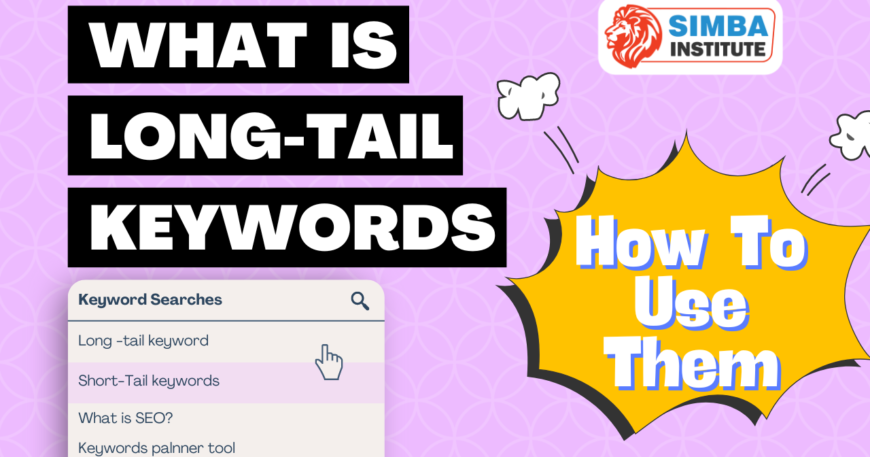
Long-tail keywords include three or more words that refer to specific products, services, or themes. For example, a wide keyword like “shoes” may generate a lot of traffic, but it is also extremely competitive. Long-tail keywords, such as “women’s black leather ankle boots,” are more precise and less competitive. While it may not produce as much traffic, it is more likely to draw customers who are actively looking to buy that specific product. Here’s information about different types of keywords  1. Broad Keywords: Short and general terms. High search volume. Often competitive.Example: “shoes.” 2. Long-Tail Keywords: Longer, more specific phrases. Lower search volume. Less competitive.Example: “women’s black leather ankle boots.” 3. Transactional Keywords: Indicate an intent to make a purchase. Often include action words like buy, order, or download.Example: “buy iPhone online.” 4. Informational Keywords: Used to find information or answers Often start with question words like “how,” “what,” “why.”Example: “how to tie a tie.” 5. Navigational Keywords: Used to find a specific website or page. Directly related to a brand or product.Example: “Facebook login.” 6. Commercial Keywords: Indicate an intent to research or compare products. Often include words like “best,” “top,” “review.”Example: “best digital cameras 2024.” Understanding different kinds of keywords is critical to creating a complete SEO and digital marketing plan. Broad keywords appeal to a large audience but are extremely competitive, whereas long-tail keywords are more specific and less competitive. Transactional keywords indicate a willingness to purchase, whereas informational keywords seek answers or guidance. Navigational keywords are used to find specific websites, whereas commercial keywords denote a research or comparison stage in the purchasing process. Businesses may increase their digital visibility and gather relevant traffic by intentionally selecting different types of keywords. Importance of Long-Tail Keywords: 1. Less Competition: Because long-tail keywords are more particular, they typically face less competition than broader terms. This means that ranking for long-tail keywords is generally easier, particularly for smaller organizations or those operating in niche markets. 2. Higher Conversion Rates: Long-tail keyword searches are more likely to happen later in the purchasing process. They know what they want, thus they are more likely to become consumers. Targeting long-tail keywords can result in increased conversion rates. 3. Better Relevance: Long-tail keywords help to ensure that your content is highly relevant to what users are searching for. This improves the user experience and increases the chances of your content being clicked on and engaged with. How to Use Long-Tail Keywords Effectively: Keyword Research: Starting by completing extensive keyword research to find right long-tail keywords for your area. Use tools like Google Keyword Planner, SEMrush, or Ahrefs to determine search volumes, competition levels, and potential keywords. Understand User Intent: Consider the intent using long-tail keywords. Are users looking for a purchase, obtain information, or research products? Tailor your material to the user’s intent for each keyword. Create High-Quality Content: Provide content that speaks to the particular requirements and questions of consumers looking for long-tail keywords. It might involve product descriptions, how-to instructions, reviews, and frequently asked questions. Optimize on-page SEO: via including long-tail keywords into your website’s metadata, headings, body content, and image alt tags. However, avoid keyword stuffing since it may interfere with the success of your SEO. Paid Advertising: Long- Tail Keywords can also be useful in paid advertising campaigns like Google Ads. Because they’re less competitive, they typically have lower cost-per-click (CPC) and more effectively click-through rates (CTR). Verify and adjust: Using analytics tools to continuously monitor the success of your long-tail keywords. Monitor rankings, traffic, and conversion data, and alter your plan as appropriate. Conclusion Long-tail keywords play a major part in modern SEO and digital marketing strategies. By targeting these specific and highly relevant search terms, businesses can attract more qualified traffic, increase conversion rates, and improve overall website visibility. However, success with long-tail keywords requires careful research, strategic implementation, and ongoing optimization. Businesses know what long-tail keywords are as well as how to use them properly.

What Are Long-Tail Keywords and how to use them? Read More »

how to use google keyword planner 1 870x457

Step 1: Access Google Keyword Planner Gaining access to Google Keyword Planner (GKP) is the first step to using it for your search engine optimization (SEO) strategy. If you don’t have one, you need to set up a Google Ads account just to go about this. To set up your account, go to the Google Ads a website and follow the instructions. Once your account has been activated, go to the Google Ads dashboard’s right-hand corner and select the “Tools & Settings” tab. Next, choose “Keyword Planner” from the “Planning” menu. You don’t need to run actual ads to use the Keywords Planner, but Google may request some initial campaign setup information. This is a great tool that is free to use. The first two options you get when you login to GKP are “Discover new keywords” and “Get search volume and forecasts.” These choices open up to a variety of keyword data that can help you create a successful SEO plan. That having a structured approach to accessing and using the Google Keyword Planner will help you maximize its full potential effectively. Step 2: Choose Your Tool Once you enter Google Keyword Planner, you have two main tools available for you: “Discover new keywords” and “Get search volume and forecasts.” Each tool has a different function. “Discover new keywords” is excellent for idea generation and discussion. You can input a seed keyword or a URL that is relevant to your business, and Google will return many of related keywords and phrases. For example, if you go into “digital marketing,” it will suggest a lot of related terms. The “Get search volume and forecasts” option, on the other hand, allows you to provide a list of previously prepared terms. In relation to those specific keywords, this tool provides you with full information on search traffic, trends, and predicted futures. If you already have a list of possible keywords and would like to have more knowledge of their possible effects, this is especially helpful. You have to choose the right tool for the job, based on how far along you are in the keyword research process—whether you are just starting to collect ideas or working on your plan with specific keywords in mind. Step 3: Filter and Sort the Results Getting the most suitable terms for your SEO plan requires filtering out the results after selecting the best tool for generating a list of keywords. Several filtering options are available in Google Keyword Planner to help you reduce your list according to specific requirements. To make sure you reach the correct audience, you can narrow down by language, location, or date range. The last option allows you to target keywords that are relevant to an area. Negative keywords were terms that are unnecessary or harmful for your content strategy. You may also eliminate them. You can decide which phrases to focus on by selecting the results by metrics like typical monthly searches, competition quantity, and bid estimates. Filtering by average monthly searches, for example, can help you find high-traffic keywords. Choosing by difficulty level, on the other hand, can help you discover less competitive, easier-to-find terms. Step 4: Analyse the Keyword Ideas Section Most of your analysis can be found in the Keyword Suggestions section. This section provides an extensive list of keywords related to your seed term as well as important information like average monthly searches, degree of competition, and bid ranges of the highest-performing keywords on the page. To find keywords that can significantly increase traffic to your website, start by analyzing the search volume. These are the terms that typically receive a high number of monthly searches. Next, assess the competition level. Ranking for highly competitive keywords may be more difficult, particularly if your SEO resources are low or you have only recently started. Try to find a balance between search volume and competition; for many SEO strategies, medium- to low-competition keywords with good search volumes represent the perfect mix. You may also evaluate a keyword’s commercial worth through a look at the top-of-page bid range; bigger bids usually translate into a keyword that advertisers feel is of greater interest. Also, it is important to analyze keyword trends. Keywords that see an increase in search volume over time are typically more profitable than those that see a decline or stability in interest. By focusing on terms that have become popular, you can use this trend data to remain ahead of other businesses. Think about how these keywords fit into your writing strategy and business objectives as you study the Keyword Ideas category. Step 5: Choose a Keyword Selecting your most effective keywords to target comes after you have done a comprehensive analysis of the data. A number of elements ought to go into this decision, such as search traffic, opposition, content relevancy, and fit with the search goals of your target audience. Give the most importance to keywords that are in line with the topics of your site, have an excellent number of searches, and have reasonable competition. If a website is about fitness, for example, a keyword like “beginning workout routines” may be more useful than a term which is very popular, like “fitness.” In order to guarantee that your target audience finds information that satisfies what they want and need once they get on your website, the search terms you choose must also match what they are actually searching for. Prepare a list of keywords organized by content clusters or themes. This framework will help you organize and structure your material more successfully. Remember, the goal is to select keywords that will deliver relevant traffic to your website and help you achieve your overall SEO objectives. Bonus Step 1: Get Exact Keyword Search Volume Data While Google Keyword Planner provides a variety of search traffic parameters, higher-quality numbers may assist you improve your keyword strategy. For precise search volume data, you may need to set up an elementary Google Ads campaign. This involves creating an

How to Use Google Keyword Planner for SEO Read More »

what is seowhy is it imporant 870x457

SEO or Search Engine Optimization is a digital marketing strategy aim at improving a website visibility and ranking in search engine result page organically without relying on paid advertising. It involves a combination of technical optimization, content creation, and off-site promotion to increase a website relevance and authority in the eyes of search engines like Google, Bing, and Yahoo. Let’s delve into each aspect of SEO in detail: Keyword Research: Understanding User Intent: Analyzing the motivation behind search queries to align content with user needs and preferences. Keyword Tools and Techniques: Utilizing various tools and methods to identify relevant keywords with sufficient search volume and low competition. Long Tail Keyword: Targeting more specific and less competitive keyword phrases to attract highly targeted traffic. On-Page SEO: Title Tag Optimization: Crafting compelling and keyword-rich title tags to improve click-through rates and search engine rankings. Meta Description Optimization: Writing concise and engaging meta descriptions that accurately summarize webpage content. Heading Tags (H1, H2, etc.): Using heading tags to structure content and signal the importance of different sections to search engines. Off-Page SEO: Link Building Strategies: Acquiring high-quality backlinks from authoritative websites to improve domain authority and search engine rankings. Social Media Marketing: Leveraging social media platforms to amplify content reach, drive traffic, and enhance brand visibility. Influencer Outreach: Collaborating with influencers and industry experts to gain exposure and attract relevant audiences. Technical SEO: Website Speed Optimization: Optimizing website performance to reduce loading times and improve user experience, which can impact search engine rankings. Mobile-Friendliness: Ensuring that websites are optimized for mobile devices to accommodate the increasing number of mobile users and meet Google’s mobile-first indexing criteria. Schema Markup Implementation: Implementing structured data markup to provide search engines with additional context about webpage content, enhancing visibility in rich snippets and other SERP features. Content Optimization: Content Strategy: Developing a comprehensive content plan aligned with audience needs, keyword research insights, and business goals. Content Creation: Producing high-quality, relevant content in various formats, including articles, blog posts, videos, infographics, and podcasts. Content Marketing: Promoting content through channels like social media, email marketing, and partnerships to increase visibility, attract backlinks, and drive traffic. Local SEO: Google My Business Optimization: Optimizing Google My Business profiles with accurate business information, photos, and reviews to improve visibility in local search results and Google Maps. Local Citations and Directories: Ensuring consistent NAP (Name, Address, Phone Number) information across online directories and local business listings to establish credibility and improve local search ranking. Local Link Building: Acquiring backlinks from local websites and directories to strengthen local search authority and relevance. Advanced SEO Strategies: E-A-T and Quality Signals: Understanding Google’s emphasis on expertise, authoritativeness, and trustworthiness (E-A-T) in evaluating website quality and relevance. Voice Search Optimization: Adapting SEO strategies to accommodate the growing use of voice-activated devices and conversational search queries. Featured Snippets and Rich Results: Optimizing content to appear in featured snippets, knowledge panels, and other rich search results to enhance visibility and attract clicks. Technical SEO Specialization: Website Architecture: Designing and optimizing website structures for improved crawlability, user experience, and information hierarchy. JavaScript SEO: Addressing technical challenges associated with JavaScript frameworks to ensure proper indexing and rendering of website content. International SEO: Optimizing websites for multilingual and multinational audiences, including hreflang tags, geotargeting, and localization strategies. SEO Analytics and Performance Measurement: Key Performance Indicators (KPIs): Identifying and tracking relevant metrics such as organic traffic, keyword rankings, conversion rates, and return on investment (ROI). Google Analytics: Leveraging Google Analytics to gain insights into website traffic, user behavior, and campaign performance, and to make data-driven decisions. SEO Tools and Platforms: Utilizing a variety of SEO tools and platforms for keyword research, rank tracking, backlink analysis, technical audits, and competitive analysis. Continuous Learning and Adaptation: Staying Updated: Keeping abreast of industry trends, algorithm updates, and best practices through blogs, forums, conferences, and online courses. Experimentation and Testing: Conducting A/B tests, split tests, and experiments to evaluate the impact of SEO strategies and refine optimization tactics. Professional Development: Pursuing certifications, training programs, and advanced courses to deepen expertise and stay competitive in the field of SEO. Importance of SEO: By focusing on these subtopics and implementing effective strategies in each area, businesses and website owners can improve their search engine visibility, attract more organic traffic, and achieve their online marketing goals.Certainly! Let’s delve deeper into the importance of SEO: Enhanced Visibility and Exposure: SEO is essential for increasing a website’s visibility on search engine results pages (SERPs). When your website ranks better for relevant search queries, it is more likely to be discovered by potential consumers. Increased visibility leads to greater exposure for your brand, products, or services. Users are more likely to click on websites that appear at the top of search results, resulting in higher traffic and brand recognition. Targeted Traffic and Qualified Leads: One of the key benefits of SEO is its ability to attract targeted traffic. By optimizing your website for specific keywords related to your industry or niche, you can attract users who are actively searching for information, products, or services that you offer. Targeted traffic is more likely to convert into leads or customers because these users have already expressed interest in what you provide. As a result, SEO helps businesses generate high-quality leads and improve conversion rates. Credibility and Trustworthiness: Users tend to view websites that rank higher in search results as more reliable and credible. This is due to the fact that search engines, such as Google, assess the value and relevancy of web sites using intricate algorithms. By optimizing your website for SEO, you demonstrate to search engines that your content is valuable, authoritative, and trustworthy. This can help build credibility with both search engines and users, leading to increased trust and loyalty. Cost-Effectiveness and High ROI: Compared to traditional advertising methods such as print, radio, or television ads, SEO offers a highly cost-effective marketing solution. While paid advertising requires continuous investment to maintain visibility, SEO can provide long-term results without ongoing expenses. Furthermore, SEO has been shown to deliver a high

What is SEO and why is it important? Read More »

Scroll to Top